
Black Bart — Bartholomew Roberts the Pirate

in the background. A copper engraving from
A History of the Pyrates by Captain Charles Johnson c. 1724
Interesting Facts: Black Bart was one of the most successful pirates of his time, with the capture of over 400 ships and over 50 million Pounds of loot. He encouraged prayer, drank a lot of tea instead of alcohol, and forbid drinking and gambling. He preferred to wear fancy gentleman’s clothes: a rich crimson waistcoat and breeches, a hat with a red feather, and a diamond cross hanging from his neck.
Bartholomew Roberts, Pirate

also known as Black Bart. Public domain.
Born John Roberts (Barti Ddu in Welsh) in Little Newcastle, southern Wales about 1682, Black Bart was the last great pirate of the Golden Age and had no equal in his day. While working as a third mate on the British slaver Princess, he was captured to be a slave — forced hand by noted pirate Howell Davis in June 1719 and elected captain when Davis was killed in attack on Principe, off the Guinea coast. Roberts leveled the town in retribution. Roberts’ Articles
Growing tired of the pickings around Guinea, Black Bart sailed to the Brazilian coast, took several good prizes, and in early 1720 went northward for some rest at Devil’s Island. His reputation arrived in the Caribbean before him, where he quickly exited and sailed north to New England to sell what he had accumulated.
Summertime 1720 was very successful in Newfoundland with many captures, most notably the plunder and sinking of all but one of 22 merchant ships in the Bay of Treffisi when the crews fled to shore just at his arrival. The spared ship was a French brig he named the Royal Fortune, which Black Bart added guns to and sailed to the Caribbean after a failed attempt to sail to Africa.
A Reluctant Pirate Who Became the Best of Them
Roberts came to piracy not by choice but by circumstance. He was 37 years old — no young romantic — when Davis pressed him into service, and by most accounts he adapted to the life with a pragmatist’s logic: “In an honest service there is thin commons, low wages, and hard labour; in this, plenty and satiety, pleasure and ease, liberty and power.” Whether he said those exact words or not, his career embodied them. Within weeks of Davis’s death his crew voted him captain, a sign that even in forced company he commanded natural respect.
What set him apart from nearly every other famous pirate of the Golden Age was the scale of what followed. Over a career of roughly 30 months, Roberts captured somewhere between 400 and 470 vessels — more than any other pirate on record. Blackbeard managed perhaps 50. Samuel Bellamy took around 50 before the sea took him. Henry Every captured one great prize and retired. Roberts simply kept going, methodical and relentless, working the shipping lanes of the Atlantic from Brazil to Newfoundland to the West African coast.
The Man Behind the Flag
Black Bart was an unusual figure by any measure. He banned gambling aboard his ships — Article III of his Articles makes it plain — and required lights out by eight at night. He forbade alcohol, drinking tea while his crew drank rum, which must have made him a singular sight on the quarterdeck. He was openly religious, holding prayer services and reportedly carrying a Bible as readily as a pistol.
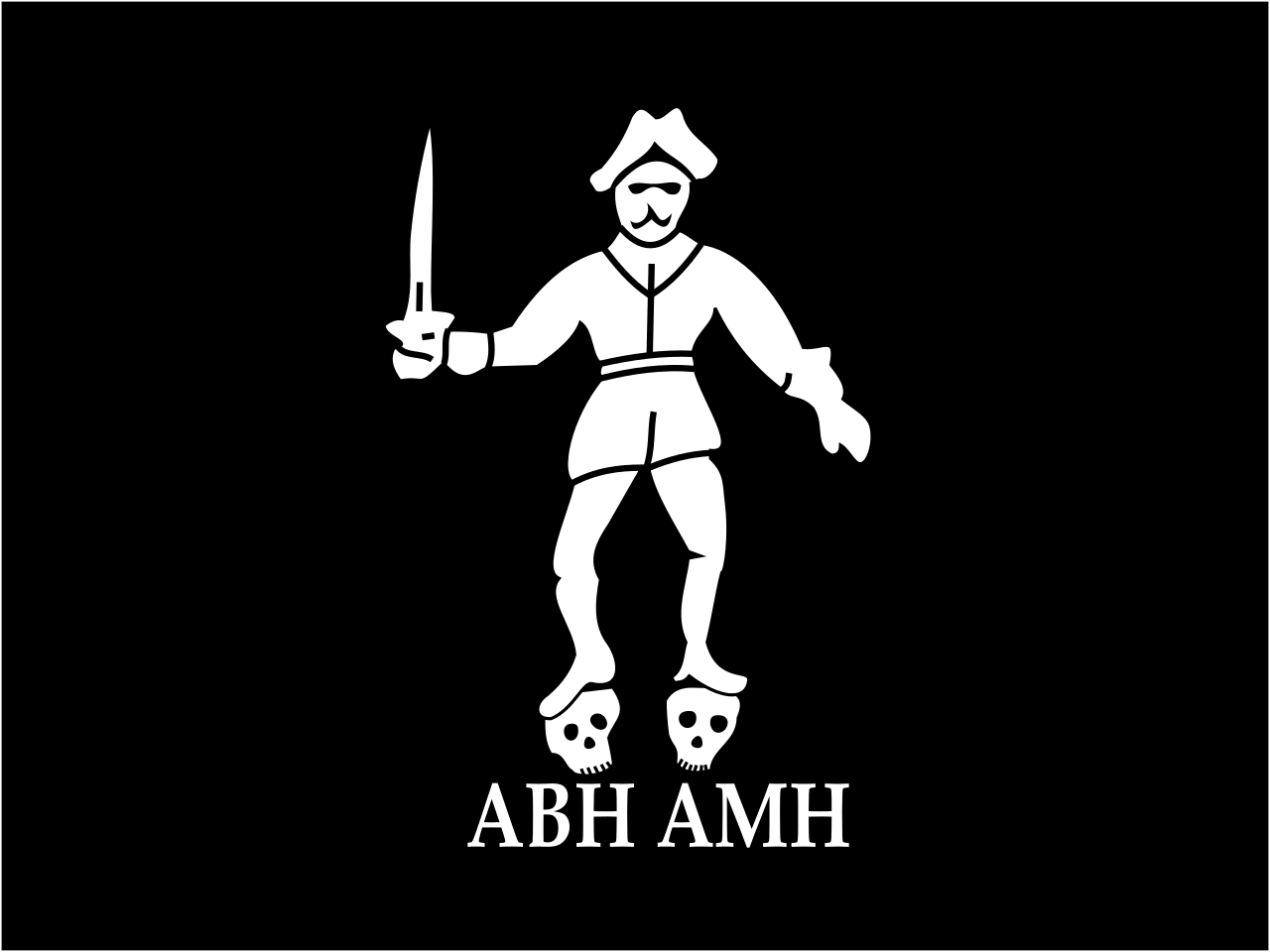
ABH & AMH: "A Barbadian's Head" and
"A Martiniquian's Head." One of the few
historically documented pirate flags. Public domain.
His appearance told a different story than his conduct. Roberts dressed for command: a rich crimson waistcoat and breeches, a hat fitted with a red feather, and a diamond cross on a gold chain at his neck — looted, as it happened, from the Portuguese King of Portugal’s own ship. When he paced the deck before an engagement he wore a brace of pistols on a silk sling across his chest and carried a sword he knew how to use. The effect was calculated. He understood that a pirate captain’s bearing was half his arsenal.
His flag reinforced the message. The ABH/AMH design — Roberts standing over two skulls, one labeled for Barbados, one for Martinique — was a direct response to governors in both colonies who had commissioned warships to hunt him. Most pirate flags of the Golden Age were simple terror symbols. Roberts’ named his enemies. It is one of the few flags from the era with documented historical basis.
The West Indies and the African Coast
In the fall of 1720, Captain Roberts began a six-month tear through the West Indies. With the almost unchallenged captures of 100 ships or more, he angered the provincial governors, one of whom he hanged after taking his warship. With shipping coming to a standstill, he went to Africa in the spring of 1721, where he learned to profit from the sale of slaves off the ships that got in his way. After careening and trading for several weeks in Sierra Leone, Black Bart headed east in August of 1721 toward Liberia, where the capture of the Royal Africa Company’s Onslow became the last Royal Fortune.

circa 1718. Public domain.
The Royal Fortune — the name Roberts gave to multiple successive flagship vessels — was by this point a substantial warship. The Onslow conversion gave him a 40-gun ship crewed by over 150 men. He worked the slaving routes between West Africa and the Americas with the same disciplined aggression he had applied everywhere else: fast attack, coordinated boarding, swift assessment of prize value, and away before any naval response could organize. The pirate crew he commanded operated more like a small navy than a mob of brigands. His Articles kept order. His competence kept them winning.
The governors of the Atlantic colonies had been trying to run him to ground for two years by the time HMS Swallow found him. Warships had been dispatched from Barbados, from Virginia, from Britain itself. He had evaded or outrun them all. The man who finally ended his career, Chaloner Ogle, was rewarded with a knighthood — the only naval officer ever knighted specifically for capturing a pirate.
The End at Cape Lopez

Swallow fight Roberts and the Royal Fortune.
by Charles Edward . Public domain.
A legendary 30-month career came to an end on February 10, 1722, when the warship HMS Swallow captained by Chaloner Ogle caught up with Black Bart off the coast of Cape Lopez (now Gabon). It is uncertain whether he was trying to escape or size up the opponent, but the grapeshot killed him either way. His crew threw his body overboard as he had always requested, and they eventually stopped their disheartened resistance.

c. 1877, Public domain.
Roberts was at the time dressed in full finery — the crimson waistcoat, the feathered hat, the diamond cross at his throat. Accounts suggest he was on deck and engaged when the grapeshot found him. He died as he had lived: conspicuous, composed, and not running. He was 39 years old.
After being thrown into prison under the Cape Coast Castle in West Africa, those who remained were given the largest pirate trial and execution of the time on March 28, 1722. 54 were hanged, 37 received prison or hard time, 70 African pirates were sold into slavery, and the rest were acquitted.

1747, Public domain.
The trial effectively marked the end of the Golden Age of Piracy. Roberts had been the last of the great captains operating at scale. With his death and the destruction of his crew, the Atlantic trade routes were no longer contested by organised pirate forces. The era that had begun in the 1690s with privateers transitioning to piracy was over. What came after — scattered opportunists, small operations, Barbary corsairs in different waters — was a different story.
Black Bart captured more ships than any pirate before or since. He ran a disciplined operation under a written code at a time when most pirate captains commanded through fear alone. He came to the life unwillingly and excelled at it anyway. Whatever his personal feelings about piracy, his record speaks plainly: 400 ships, two oceans, 30 months, and a death on his feet on his own quarterdeck.
📖 The Republic of Pirates — Colin Woodard’s narrative history covers the Nassau years and the broader world Roberts operated in. The best single-volume account of the era. The Republic of Pirates on Amazon → (Amazon affiliate link)Bartholomew Roberts’ Articles
ARTICLE I. Every man shall have an equal vote in affairs of moment. He shall have an equal title to the fresh provisions or strong liquors at any time seized, and shall use them at pleasure unless a scarcity may make it necessary for the common good that a retrenchment may be voted.
ARTICLE II. Every man shall be called fairly in turn by the list on board of prizes, because over and above their proper share, they are allowed a shift of clothes. But if they defraud the company to the value of even one dollar in plate, jewels or money, they shall be marooned. If any man rob another he shall have his nose and ears slit, and be put ashore where he shall be sure to encounter hardships.
ARTICLE III. None shall game for money either with dice or cards.
ARTICLE IV. The lights and candles should be put out at eight at night, and if any of the crew desire to drink after that hour they shall sit upon the open deck without lights.
ARTICLE V. Each man shall keep his piece, cutlass and pistols at all times clean and ready for action.
ARTICLE VI. No boy or woman to be allowed amongst them. If any man shall be found seducing any of the latter sex and carrying her to sea in disguise he shall suffer death.
ARTICLE VII. He that shall desert the ship or his quarters in time of battle shall be punished by death or marooning.
ARTICLE VIII. None shall strike another on board the ship, but every man’s quarrel shall be ended on shore by sword or pistol in this manner. At the word of command from the quartermaster, each man being previously placed back to back, shall turn and fire immediately. If any man do not, the quartermaster shall knock the piece out of his hand. If both miss their aim they shall take to their cutlasses, and he that draweth first blood shall be declared the victor.
ARTICLE IX. No man shall talk of breaking up their way of living till each has a share of £1,000. Every man who shall become a cripple or lose a limb in the service shall have 800 pieces of eight from the common stock and for lesser hurts proportionately.
ARTICLE X. The captain and the quartermaster shall each receive two shares of a prize, the master gunner and boatswain, one and one half shares, all other officers one and one quarter, and private gentlemen of fortune one share each.
ARTICLE XI. The musicians shall have rest on the Sabbath Day only by right. On all other days by favour only.
As both an Amazon and eBay Associate I earn from qualifying purchases.
All content ©2003– The Pirate's Realm unless otherwise noted. All rights reserved.